This initiative will perform a comprehensive, campus-wide assessment of base budget funding allocations, and transform UConn’s budget model into a more modernized, equitable, and strategic process for allocating funds with the goal of simplifying the budget process, increasing transparency, and building incentives to create innovative and efficient strategies.
- Increased transparency of the budget and allocation methods
- Build incentives into the model to create efficiencies and work toward institutional priorities
- Create a model based on quantitative and qualitative metrics to guide decision making and use of resources
Presentation: Budget Transformation Initiative Communication Plan
UConn Today: UConn Launches Initiative to Build More Efficient, Equitable, Transparent Budgeting
Listening Session Presentation – October 2025:
Presentation Materials
10/20/25 Session Recording
10/21/25 Session Recording
Presentation: Board of Trustees – December 2025 Meeting
| August 12, 2025 | Council of Dean’s Presentation |
| September 16, 2025 | BOT Financial Affairs Committee |
| September 17, 2025 | Board of Trustees Meeting |
| September 23-25, 2025 | Unit Level Discovery Interviews |
| October 6, 2025 | University Senate Meeting Presentation |
| October 20, 2025 4:00-6:00 PM |
University-wide Listening Sessions Student Union Theatre (SU 101) |
| October 21, 2025 11:00 AM-1:00 PM |
University-wide Listening Sessions Student Union Theatre (SU 101) |
| October 28, 2025 10:00 AM |
Board of Trustees Financial Affairs Committee Presentation |
| November 2025 | Working Group Meetings Kick-Off |
| December 2, 2025 10:00 AM |
Board of Trustees Financial Affairs Committee Presentation |
| February 6, 2026 | Working Group Summit |
| March/April 2026 * | Unit Leader Meetings |
| May 2026 * | Town Halls |
| End of FY26 | Prototype Budget Model Release |
| July 1, 2026 | Shadow Year Begins |
| Fall 2026 | Unit Leader Meetings: Forward Looking Model Early-Look |
| July 1, 2027 | Governance Plan and Finalized Budget Model Go-Live |
* Certain dates are preliminary and subject to change.
Devon McGee, Principal & Project Manager, Kennedy & Co.
Emily Murphy, CPA, Senior Manager, Kennedy & Co.
Grant Blumberg, Senior Analyst, Kennedy & Co.
Reka Wrynn, Interim Vice President for Finance and Associate Vice President for Budget, Planning & Institutional Research, UConn
Kelly Wihbey, Assistant Vice President, Budget & Financial Planning, UConn
Kate Clark, Associate Vice Provost for Academic Finance, UConn
Danielle Sullivan, Associate Director, Operating Budget, UConn
Reka Wrynn, Interim Vice President for Finance
Pamir Alpay, Interim Provost
Dan Schwartz, Vice Provost for Academic Operations
Amy Gorin, Vice Provost for Health Sciences and Interdisciplinary Initiatives
Phil Hunt, Chief of Staff
Robert Day, Chair, University Senate Executive Committee; Professor, School of Business
Nathan Fuerst, Vice President for Student Life & Enrollment
Mike Kirk, Vice President for Communications
Lindsay DiStefano, Interim Vice President for Research
Deanna Fitzgerald, Dean, School of Fine Arts
Ofer Harel, Dean, College of Liberal Arts & Sciences
Jennifer Orlikoff, Dean, Stamford Campus Dean & Chief Administrative Officer
1. Oskar Harmon, Associate Professor, CLAS
2. Amy Harder, Associate Dean and Assoc Director for Extension, CAHNR Extension
3. Kane Lynch, Executive Director, Shared Services, CLAS
4. Sandy Li, Director of Finance and Administrative Services, Stamford Campus
5. Kerrie Alberts, Associate Finance Director, College of Engineering
6. Eric Rosario, Associate Bursar, Office of the Bursar
7. Sue Peters, Director, Office of Student Financial Aid Services
8. Lisa Gorman, Finance Director, The Graduate School
9. David Bergman, Associate Dean, School of Business
10. Molly Land, Associate Dean, School of Law
11. Connie Bedan, Assistant Dean for Finance and Administration, School of Nursing
12. Laura Curran, Dean and Professor, School of Social Work
13. Daniel Schwartz, Vice Provost for Academic Operations, Office of the Provost
1. Michael Morrell, Associate Professor, CLAS
2. Dan Burkey, Associate Dean, College of Engineering
3. Dan Mercier, Director, Academic Affairs, Avery Point Campus
4. Rori Ziegwied, Senior Financial Analyst, Information Technology Services/Budget, Planning & Institutional Research
5. Mansour Ndiaye, Assistant Dean, CLAS
6. Tammie Corioso, Director, FO Business Service Center, Facility Services and University Planning
7. Darshana Sonpal, Director, Business Services, University Safety
8. Anne Langley, Dean, Library
9. Tracy Anderson, Executive Director for Creative Strategy and Brand Management, University Communications
10. Stacy Russolino, Manager of Financial Reporting, Lead Accountant, Office of the AVP of Financial Operations and Controller
11. Alicia Huckle, Assistant Dean for Finance and Administration, CAHNR
12. Brandon Murray, Director, Human Resources
1. Ken Lachlan, Professor, Department Head, CLAS
2. David Clokey, Assistant Vice President for Administrative Services, Student Life & Enrollment
3. Kim Proulx, Director of Housing Administration and Finance, Campus Housing
4. Krista O’Brien, Associate Director/Director for Trustee Student Org Support, Student Activities
5. Mike White, Executive Director, Dining Services
6. Suzanne Onorato, Executive Director, Student Health & Wellness
7. Stephanie Rimoczy, Associate Business Director, Facility Services and University Planning
8. Bill Guerrero, Senior Associate Athletic Director for Financial Affairs, Athletics
9. Melissa Frain, Assistant Director, Business and Membership Services, Recreation
10. Clarissa Girasoli, Manager of Cost Analysis, Office of the AVP of Financial Operations and Controller
11. Liz Solecki, Tax Manager, Office of the AVP of Financial Operations and Controller
12. Colleen Bridgeman, Assistant Dean, Chief Operations Officer, School of Fine Arts
1. David Weber, Professor, Deloitte Foundation Professor of Accounting, School of Business
2. Fumiko Hoeft, Campus Dean and Chief Administrative Officer, Waterbury Campus
3. Fany Hannon, Dean of Students, Dean of Students Office
4. Jeff Gagnon, Executive Advisor for Enrollment Analytics, Student Life & Enrollment
5. Tadarrayl Starke, Vice Provost for Undergraduate Student Success, Office of the Provost
6. Eric Kruger, VP for Facility Services and Univ Planning, Facility Services and University Planning
7. Joanne Lombardo, Senior Director, Government Relations
8. Michelle Williams, Associate Vice President of OVPR, Office of the Vice President for Research
9. Kyle Muncy, Director of Brand Partnerships, University Communications
10. Jason Irizarry, Dean, NEAG School of Education
11. Kylene Perras, Assistant Dean, College of Engineering
12. Jennifer Lease Butts, Associate Vice Provost for Enrichment Programs, Honors Program
1. Tricia Leahey, InCHIP Director, Professor of Allied Health Sciences, CAHNR/InCHIP
2. Julie Schwager, Executive Director for Operations; AVP for Research Finance, Office of the Vice President for Research
3. Nancy Redeker, Professor and Senior Associate Dean for Research and Scholarship, School of Nursing
4. Allison Goldsnider, Director of Grants Management Services, CLAS
5. Nathan Alder, Professor, Molecular and Cell Biology, CLAS
6. Thanh Nguyen, Associate Professor, College of Engineering
7. Jim O’Donnell, Professor of Marine Sciences, CLAS, CIRCA, Avery Point Campus
8. Morgaen Donaldson, Associate Dean of Research, NEAG School of Education
9. Jennifer Manuel, Professor and Associate Dean for Research, School of Social Work
10. Anna Mae Duane, Professor and Director of Humanities Institute, CLAS, Humanities Institute
11. Laurent Michel, Professor, College of Engineering
12. David Embrick, Associate Professor and Director, CLAS, Hartford Campus
13. Leslie Shor, Vice Provost for Graduate Education, Office of the Provost, The Graduate School
13. José Manautou, Department Head of Pharmaceutical Sciences, Professor, School of Pharmacy
Give anonymous
feedback here
Frequently Asked Questions (FAQs)
This initiative will perform a comprehensive, campus-wide assessment of base budget funding allocations, and transform UConn’s budget model into a more modernized, equitable, and strategic process for allocating funds with the goal of simplifying the budget process, increasing transparency, and building incentives to create innovative and efficient strategies. This is a two-year process, with an anticipated go-live date of July 1, 2027.
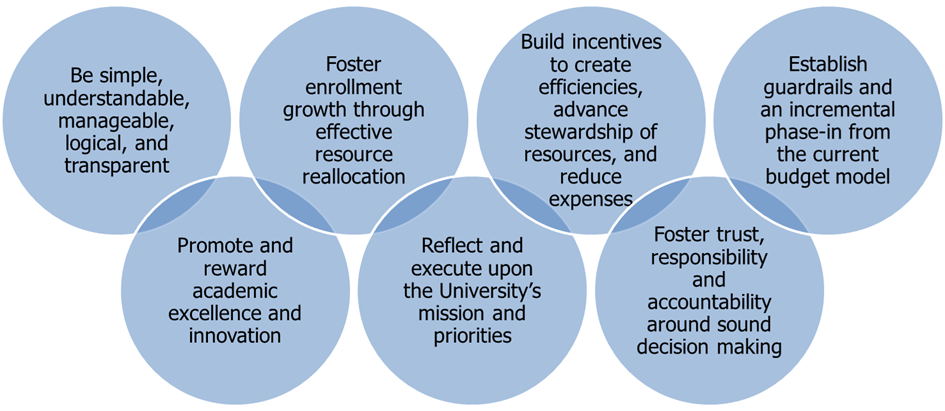
UConn’s transformed budget model seeks to include:
- Alignment with UConn’s mission and priorities
- Academic excellence and innovation
- Rewards for enrollment growth
- Incentives for efficiencies
- Trust in decision making
- Guardrails for accountability
- Simplicity and transparency
No. The transition to a decentralized budget model is focused on increasing financial transparency, incentivizing units to work towards institutional goals, and better aligning resources with activity levels across the institution. Staffing decisions will continue to be made by academic and administrative leadership based on strategic priorities and operational needs.
The transformation project is designed to engage the entire UConn community. Interviews will be conducted in mid-September with leaders of all academic units, including regional campuses, and most non-academic units. Additionally, working groups will be convened to discuss and assess various options under consideration and provide feedback and recommendations in a group setting. Lastly, listening sessions and town halls will be conducted to give all faculty and staff the opportunity to ask questions and receive feedback.
The University recognizes a need to bolster financial transparency, accountability, and efficiency, beyond what the current budget model can support. The new model will encourage innovation, such as the creation of new programs and entrepreneurial activity, and provide incentives around enrollment growth, spending efficiency, and other institutional priorities.
No, the budget model does not solve the structural deficit that the University is facing. While the model will likely incentivize revenue generation and expense reduction, the primary purpose is to allocate existing operating funds (mainly tuition dollars and state support) across units in a transparent way based on a variety of metrics.
No, the organizational assessments are part of a separate initiative being conducted by Segal. They are not related to this initiative.
The current budgeting approach will be used for fiscal year 2027 (beginning July 1, 2026), although the new prototype model will operate concurrently to allow the project team to compare the old and new approaches and refine the model as needed. During this time, unit leaders will get an early look at the new model, and a Governance Plan will be put into place.
The new budget model includes all units within the Storrs and regional campuses. It does not include UConn Health.
UConn leadership is aware of the challenges associated with traditional decentralized budget models, including the risk of underfunding high-value, mission-critical activities that do not directly generate revenue. To ensure that UConn’s model supports the full breadth of its mission, including research, graduate education, public engagement, and interdisciplinary education and research, the University has partnered with Kennedy & Company, an experienced consulting firm with expertise in higher education finance and incentive-based budget model implementations. Kennedy’s role is to facilitate these very important discussions and help UConn to account for pitfalls that other institutions may have encountered. In addition, they will share general ideas and concerns to guide us based on their experience in building budget models.
While the process will be supported by Kennedy & Company, the model will ultimately be tailored to UConn’s needs and all recommendations will come from Working Groups and be approved by the Steering Committee. To ensure that the model that is currently under development will be uniquely tailored to UConn’s strategic priorities, Kennedy & Company has engaged 100+ stakeholders from across academic, auxiliary, and administrative units in interviews to ensure the model recognizes and accounts for the distinctive missions, accreditation requirements, delivery methods, and research portfolio of each academic unit.
Listening sessions and the anonymous feedback form linked to this webpage are another University-wide opportunity to provide feedback and ideas for incentives to recognize these programs.
Working Groups composed of academic and administrative leaders are being convened to examine how best to recognize and support mission-critical activities. These groups are charged with identifying appropriate incentives, funding mechanisms, and safeguards to ensure such programs are not only protected but appropriately valued in the budget model. Ultimately, it will be our employees across academic and non-academic units developing the recommendations in Working Groups, with the Steering Committee making final decisions.
The BTI process has been designed to promote transparency, autonomy, innovation, and strategic investment—ensuring that essential functions like non-grant-funded research, graduate education, and other parts of the University mission continue to thrive and are supported financially as part of UConn’s core mission in the new budget model.
There will be five working groups, each comprised of approximately twelve members. The working groups are:
- Tuition & Fees and State Appropriations
- Academic Unit and Central Services Costs
- Research and Scholarly Activities
- Strategic Initiatives
- Auxiliary Units
The Budget Transformation Initiative is not a cost-cutting project. The development of UConn’s new budget model is a collaborative effort between academic, auxiliary, central and other units, with an emphasis on ensuring that all academic units and regional campuses have representation. The central service functions are fundamental to delivering on UConn’s mission and need to be supported in order to educate students and conduct research, and the BTI will help provide a greater transparency in how central service units – as well as academic and auxiliary units – are funded.
Feedback received in discovery interviews and listening sessions will be leveraged to address concerns and the budget model will build guardrails to transparently outline the funding of central service units. Working Groups, comprised of a cross-section faculty, associate deans, representatives of regional campuses, and non-academic unit leaders and staff, will examine how to incorporate the heightened transparency into the budget model and ensure that the right set of support and accountability exists for cost centers.
Once the model is developed and approved by the steering committee, it will be shared with deans and other unit leaders in Spring 2026.
Yes, the formulas and outcomes will be shared with the Steering Committee, deans, and leaders of auxiliary and central service units. A primary benefit of this new model is that funding allocations, revenue and costs are built based on clear, understandable metrics that will be made transparent by unit level to stakeholders based on mathematical formulas.
Discovery interviews were conducted with the deans and business officers at each of the four regional campuses. Representatives from regional campuses are also included on the Steering Committee and in each of the five working groups.
Support for the regional campuses within UConn’s future is part of the institution’s mission and a key priority in the new budget model.
One common criticism of decentralized budget models is that, if not designed properly, they can create competition between units over fostering collaboration. During the discovery interview process, stakeholders commonly expressed a strong desire to ensure that collaboration between units and interdisciplinary program development be addressed in the new incentive-based budget model.
The model will also include central support for institution-wide strategic initiatives, which can include initiatives encouraging partnerships between units as a positive incentive.
There is no perfect budget model. As the new model is implemented, there will be nuances and exceptions that emerge. We anticipate that in the first version of the model, new variables might be introduced that we cannot yet fully anticipate. We will continuously monitor and plan for future adjustments as needed.
We recognize the importance of building the model to be adaptive and flexible for unforeseen future needs and also recognize that key decision points in the model will need to be revisited in future years to ensure alignment with shifting institutional priorities.
The thoughtful implementation of a fair, transparent, incentive-based budget model is important. Without proper guidance, other institutions have tried, and failed, to implement models that are easy to understand, give proper incentives, and foster accountability.
To ensure this implementation is successful, the University issued a Request for Proposal and held a competitive bid process to identify the best qualified candidate. Among evaluation criteria, the applicants’ financial proposal carried the most weight in the final outcome.
Our chosen firm, Kennedy & Co., offered the best combination of service, experience, and value for the two-year long Budget Transformation Initiative. Kennedy & Co brings extensive higher education budget and finance experience with institutions similar to UConn. Kennedy & Co. has been a strong partner in ensuring that the BTI includes a wide cross-section of the University, ensuring transparency, and avoiding unintended consequences in the new budget model.
You can find more information and scholarly articles at the following links. Please note that UConn is developing a hybrid model informed by input from across the University community. As such, certain information may not fully align with UConn’s evolving decentralized model.
Please contact Danielle Sullivan (danielle.l.sullivan@uconn.edu) with any questions.